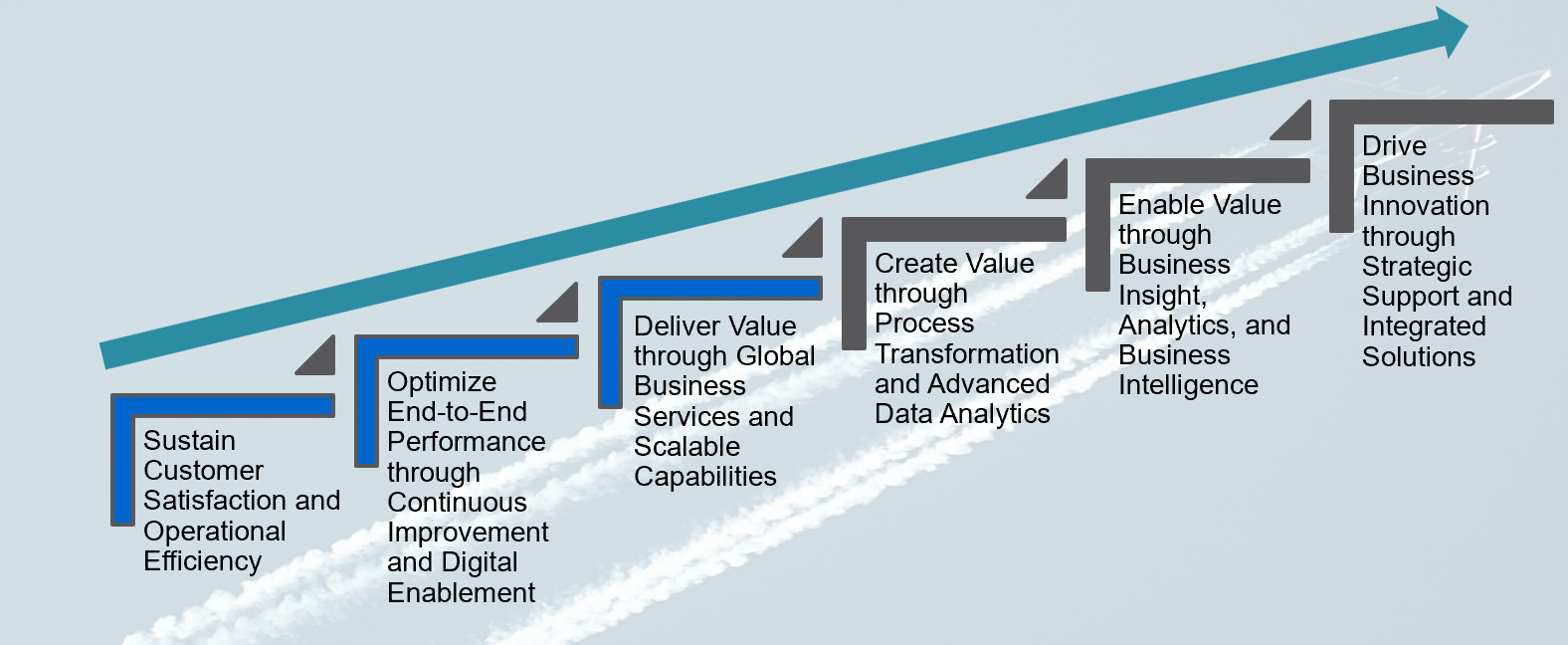
Global Business Services Partnering Operating Model
For more than two decades, organizations around the world have relied on shared services to improve operational efficiency, enhance control frameworks, and reduce costs. These foundational benefits remain important today, but they are no longer sufficient. The expectations placed on leading Global Business Services (GBS) organizations have fundamentally changed.
Modern GBS organizations are no longer evaluated solely on transactional excellence. Instead, they are expected to act as strategic partners, contributing directly to business outcomes. Mature GBS models now deliver value in highly specialized domains such as tax compliance, statutory reporting, project controlling, marketing, and credit management. At the same time, they increasingly play a central role in transformation agendas, including change management, digital enablement, and innovation.
This evolution has shifted stakeholder perception. GBS is no longer seen as a back-office processing engine. It is increasingly recognized as an integral part of the enterprise value chain, enabling strategy execution and driving competitive advantage. In this context, the GBS Partnering Operating Model emerges as a critical capability, redefining how GBS interacts with business functions and contributes to enterprise success.
The Shift to Value-Centric GBS
At the heart of the Partnering Operating Model lies a fundamental shift: from cost efficiency to value contribution.
GBS organizations deliver value across multiple dimensions, including quality, efficiency, data stewardship, and process transformation. However, the distinguishing factor of leading GBS models is their ability to integrate deeply into the value chains of corporate functions. Rather than operating as isolated service providers, they become co-creators of business outcomes.
Digitalization accelerates this transformation. Technologies such as automation, advanced analytics, and data visualization enable GBS to move beyond standardized processing and provide actionable insights. Routine, low-complexity tasks are increasingly automated, freeing capacity for higher-value activities such as decision support, scenario modeling, and process innovation.
This shift creates a powerful opportunity: GBS evolves from a cost center into a value orchestration layer, connecting data, processes, and capabilities across the enterprise.
Shared Objectives as the Foundation of Partnership
A true partnership requires alignment. The success of the GBS Partnering Operating Model depends on the extent to which GBS and corporate functions operate against shared objectives.
GBS objectives must not exist in isolation. They need to be directly linked to business priorities, whether those relate to growth, profitability, compliance, or innovation. When alignment is achieved, GBS can act as a strategic enabler, supporting the development of new business models, accelerating product innovation, and enhancing customer value propositions.
This alignment becomes even more critical as organizations respond to structural shifts in technology, data, and talent. Automation and digitalization redefine how work is performed, while talent strategies increasingly emphasize upskilling and cross-functional collaboration.
GBS holds a unique vantage point in this context. Positioned at the intersection of functions, geographies, and processes, it has the ability to identify synergies, standardize practices, and scale innovation. When guided by shared objectives, GBS becomes a force multiplier for enterprise strategy.
Process Excellence as a Platform for Innovation
Process excellence has always been a core competency of GBS. However, in the Partnering Operating Model, its role expands significantly.
Rather than focusing solely on efficiency and standardization, GBS leverages its expertise to reimagine processes end to end. Using data, technology, and domain knowledge, it identifies opportunities to improve performance, reduce complexity, and enhance user experience.
Leading GBS organizations are increasingly recognized as centers of expertise and innovation hubs. They deploy advanced capabilities such as predictive analytics, robotics, and digital workflows to create new forms of value. For example, predictive models can anticipate financial risks, while process mining tools can uncover inefficiencies and inform redesign initiatives.
Importantly, process excellence is no longer a standalone objective. It becomes a platform for continuous transformation, enabling organizations to adapt to changing market conditions and regulatory environments.
Integrated Leadership for a Complex Environment
As GBS takes on a more strategic role, leadership requirements evolve accordingly. The Partnering Operating Model demands integrated leadership, combining operational excellence with transformation capabilities.
GBS leaders must be able to balance two imperatives: running the business efficiently and driving innovation simultaneously. This requires a broader skill set that includes digital literacy, data-driven decision making, and the ability to lead cross-functional transformation initiatives.
Integrated leadership also implies shared governance structures. Decision-making is no longer confined within functional silos. Instead, it is distributed across collaborative platforms that bring together GBS and business stakeholders. These platforms enable joint decisions on critical topics such as digital investments, capability building, and talent strategy.
The result is a shift from hierarchical control to co-creation and co-ownership, strengthening alignment and accelerating execution.
End-to-End Process Ownership
One of the most defining characteristics of the Partnering Operating Model is the emphasis on end-to-end process ownership.
Traditional shared services were often limited to specific process fragments, resulting in fragmented accountability and suboptimal outcomes. In contrast, modern GBS organizations take responsibility for the full process lifecycle, from design to execution and continuous improvement.
This end-to-end perspective enables GBS to drive meaningful transformation. By understanding how processes interact across functions, it can identify systemic issues and implement holistic solutions. Initiatives such as design thinking, user experience optimization, and next-generation ERP implementation become natural extensions of this role.
Moreover, GBS is uniquely positioned to scale these improvements globally. Its cross-functional reach and standardized platforms allow best practices to be replicated efficiently across the organization.
Accountability as a Cornerstone of Governance
A robust accountability matrix is essential to make the Partnering Operating Model work in practice.
As responsibilities shift and become more integrated, clear definition of roles and ownership is critical. The accountability matrix establishes who is responsible for what across the end-to-end process landscape, ensuring transparency and avoiding duplication or gaps.
However, accountability is not only about structure. It is also about joint ownership of outcomes. GBS and corporate functions must collaborate closely to define priorities, develop innovation roadmaps, and monitor performance against shared KPIs.
This approach creates a governance model that combines clarity with flexibility. It supports both operational stability and dynamic adaptation, enabling organizations to respond effectively to new challenges and opportunities.
The Path Forward: Empowered GBS
The transition to the Partnering Operating Model represents a significant step in the evolution of GBS. It requires organizations to rethink not only processes and technologies, but also mindsets and ways of working.
Leading organizations are already moving in this direction by empowering their GBS entities with greater autonomy and broader mandates. This empowerment allows GBS to take ownership of transformation initiatives, invest in capabilities, and proactively drive innovation.
The implications are profound:
· GBS becomes a strategic partner, not a service provider
· Processes are managed end to end, rather than in silos
· Value is measured in business outcomes, not only cost savings
· Leadership shifts from control to collaboration and co-creation
Closing Reflection
The evolution of Global Business Services is far from complete. Yet one thing is clear: the future of GBS lies in its ability to connect strategy with execution. The Partnering Operating Model provides a compelling framework for this transformation. It positions GBS at the center of the enterprise, where it can orchestrate processes, leverage data, and drive innovation at scale. For organizations willing to embrace this model, the rewards are significant. GBS becomes not only a platform for efficiency, but a lever for strategic advantage.