Moving Up the Value Curve
In many organizations, the evolution of Global Business Services follows a familiar pattern. It does not begin with ambition. It begins with necessity.
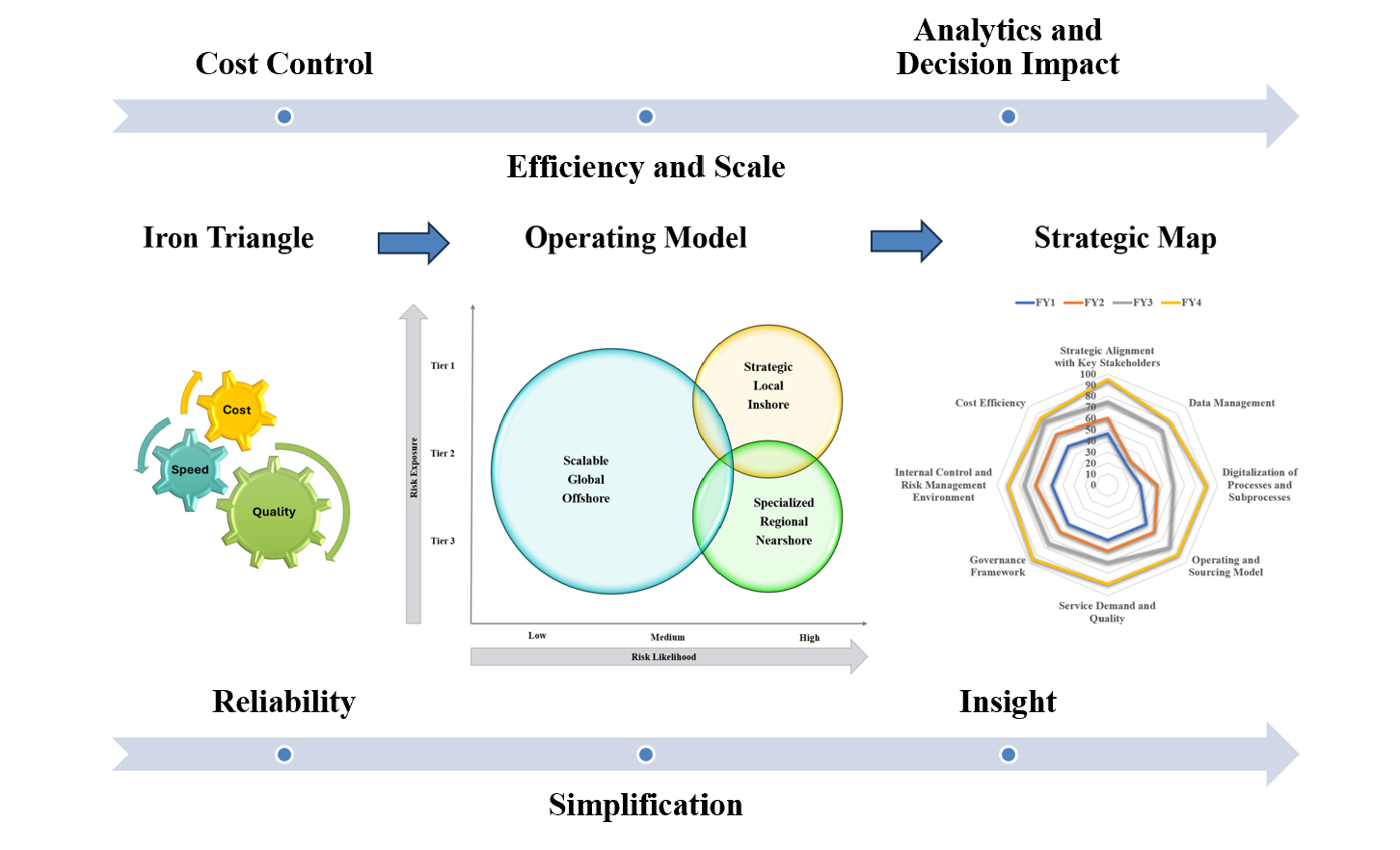
The first objective is clear and often non-negotiable. Services must become reliable. Costs need to come down. Processes must be controlled. Compliance has to be ensured. Without this foundation, nothing else holds.
What is less obvious in the early stages is that this is not the end of the journey. It is only the beginning.
Establishing reliability as a foundation
Every successful Global Business Services organization starts by bringing order to complexity. Processes are standardized, roles are clarified, and outcomes become predictable. Effectiveness improves because activities are no longer fragmented. Costs come down because duplication is removed. Quality becomes visible because it is measured.
At this stage, the value created is primarily defensive. Risks are reduced. Errors are contained. The organization begins to trust that essential services will be delivered as expected.
This is often underestimated. Reliability is not a basic state. It is the result of discipline, consistency, and managerial attention applied over time.
Simplifying to create momentum
Once reliability is established, the focus shifts. The organization begins to ask a different set of questions. Not only whether things are done correctly, but whether they should be done at all, and how they can be done more simply.
Simplification introduces a new form of value. Efficiency improves, not only through cost reduction, but by reducing effort across the system. Processes become easier to navigate. Scale begins to work in favor of the organization rather than against it. Customer experience, often neglected in earlier stages, becomes a relevant consideration.
At this point, Global Business Services start to change how the organization feels. Interactions become smoother. Friction is reduced. The business spends less time managing processes and more time focusing on outcomes.
Yet even this stage does not fully capture the potential.
From execution to insight
The most significant shift occurs when Global Business Services move beyond execution and begin to contribute to understanding.
Data, which was previously collected to support transactions and reporting, becomes a source of insight. Patterns are identified. Deviations are explained. Decisions are informed by clarity rather than assumption.
This is where analytics emerges as a defining capability. The value created is no longer limited to efficiency gains or process improvements. It extends into financial performance, operational effectiveness, and strategic decision making.
In this stage, Global Business Services help increase revenue and reduce cost not only by how work is performed, but by what is understood.
A journey that requires consistency
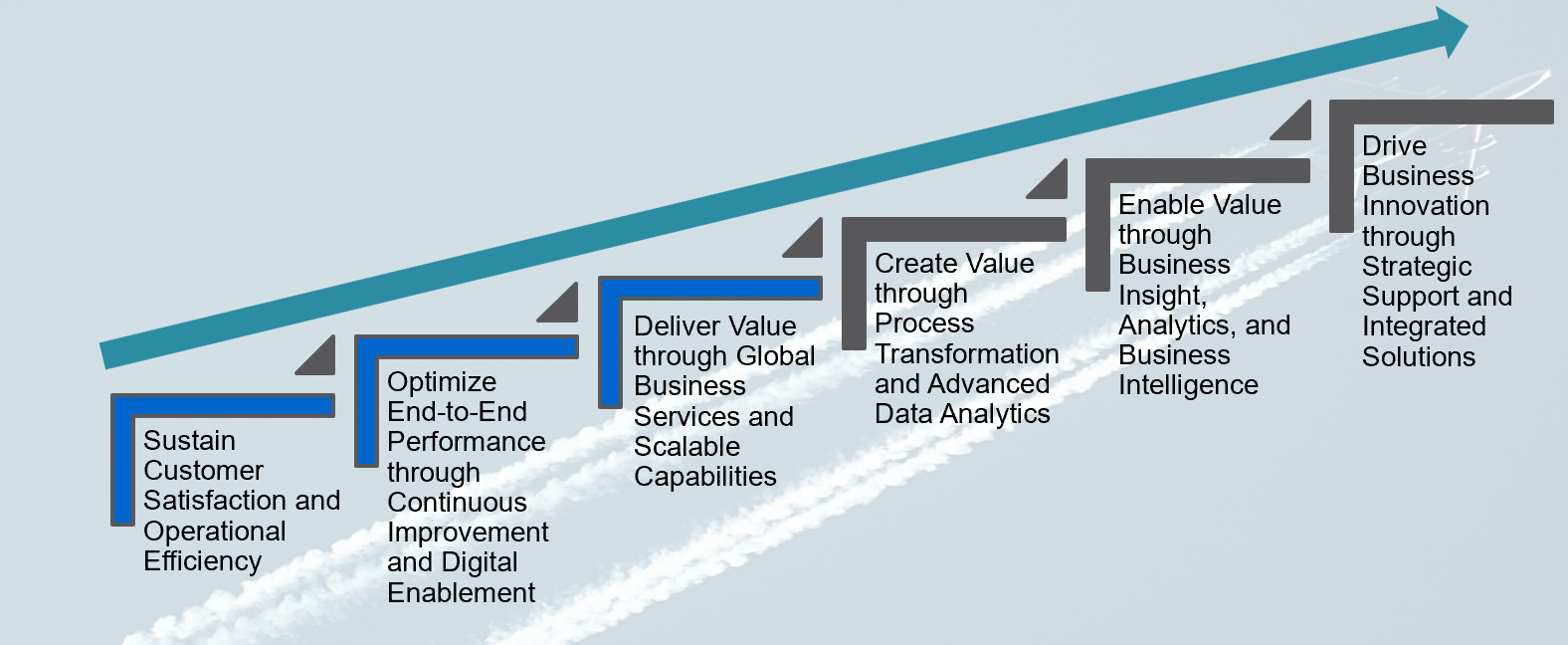
What the image illustrates particularly well is that this progression does not happen all at once. It unfolds over time.
An organization may focus on reliability in one phase, consolidate and stabilize in the next, and only then expand into more advanced contributions. Each stage builds on the previous one. Skipping steps is rarely successful.
The discipline required is not only technical. It is managerial. Leaders must resist the temptation to accelerate prematurely, while at the same time maintaining a clear vision of the destination.
From support function to value creator
When Global Business Services reach this level of maturity, they are no longer perceived as a support function in the traditional sense.
They become a source of value that is embedded in how the organization operates. Their contribution is visible in better decisions, clearer accountability, and improved performance across functions. The business relies on them not only to execute, but to understand.
This transition changes the conversation. Instead of asking how much cost can be reduced, the question becomes how much value can be created.
The role of intent
What ultimately determines whether this journey succeeds is not the model itself. The steps are widely understood. The challenge lies in execution.
Each stage requires deliberate intent. Reliability requires discipline. Simplification requires courage to challenge existing practices. Insight requires investment in capability and a willingness to rethink roles.
Technology, including advanced analytics and artificial intelligence, plays an important role in enabling this progression. However, it does not define it. Technology accelerates what is already designed and managed with clarity. It cannot substitute for it.
A broader perspective on excellence
Seen in this light, the evolution of Global Business Services reflects a broader principle of management.
Excellence is rarely achieved by focusing on outcomes alone. It emerges when organizations consistently align structure, capability, and intent over time. What begins as a cost initiative gradually becomes a value platform. What starts as execution evolves into contribution.
The movement up the value curve is not just a transformation of services. It is a reflection of how an organization learns to manage itself better.