The Blueprint to Excellence
A management perspective on Global Business Services (GBS).
In management, excellence is rarely the outcome of bold declarations. More often, it is the result of many consistent decisions taken over time. Decisions about priorities, trade offs, accountability, and purpose shape outcomes far more than any single initiative ever could.
Global Business Services offer a clear illustration of this dynamic. Few leaders question their necessity today. Yet many still struggle with a more fundamental question. What does excellence in Global Business Services actually look like in practice? The answer is not found in structures alone. It requires a way of thinking that brings direction, coherence, and intent to those structures. In other words, it requires a blueprint.
Excellence starts with fundamental balance
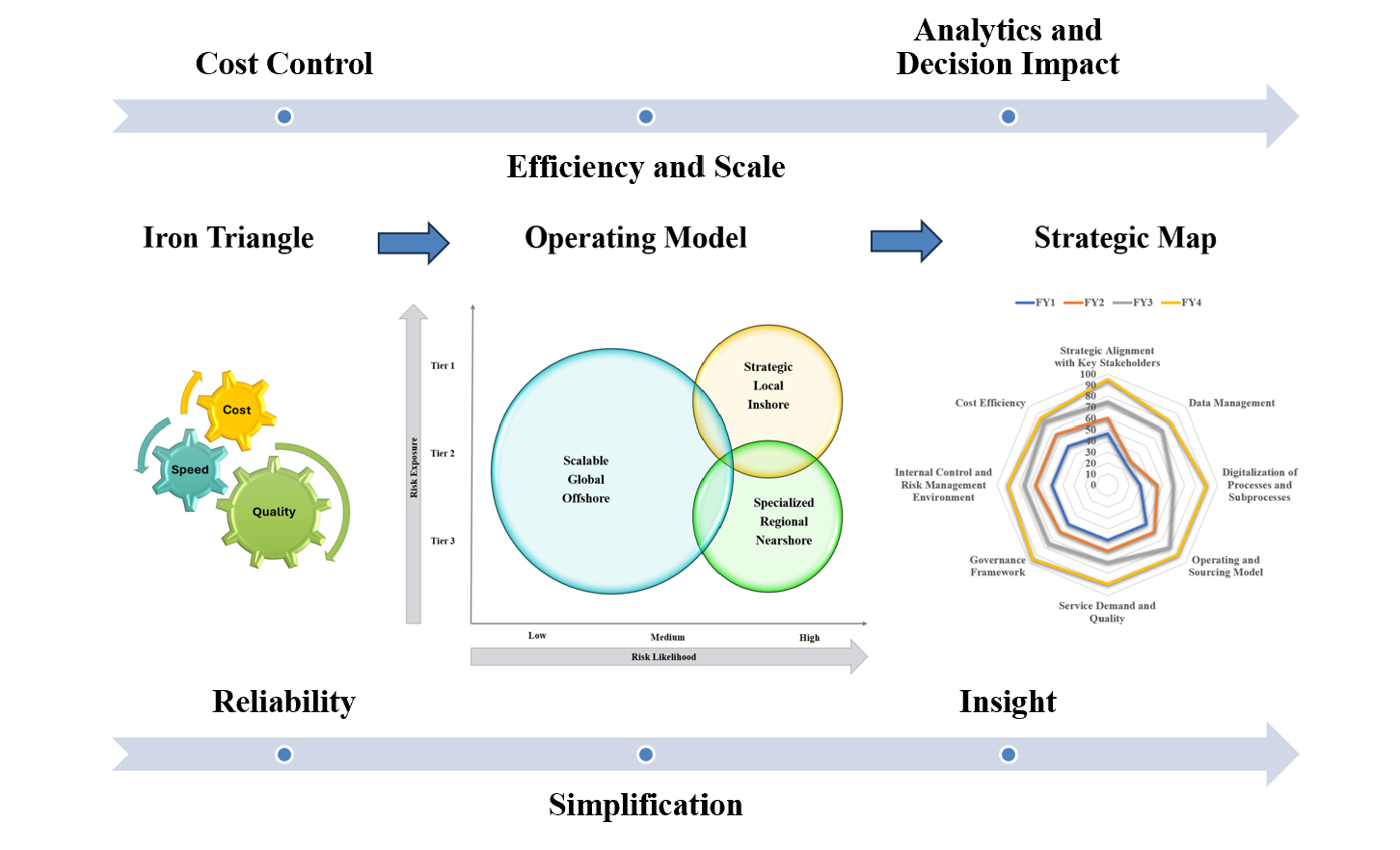
Every support organization operates within a tension that cannot be ignored. The business expects lower cost, faster delivery, and higher quality at the same time. Treating these expectations as competing demands inevitably leads to defensive behavior and, at best, incremental improvement.
Excellence begins when leaders accept this tension as their responsibility rather than their excuse.
Organizations that move forward take a different stance. They focus on doing less work, not just cheaper work. They challenge demand, simplify processes, and remove unnecessary complexity before discussing location or scale. Technology becomes a stabilizer of quality and speed, not merely a productivity tool.
When cost discipline goes hand in hand with reliability and responsiveness, something important changes. The conversation shifts from justification to trust.
How work is organized matters more than where it is done
Once trust is established, the real management questions emerge. Where should judgment reside? Which activities benefit from scale, and which require proximity? Where is risk acceptable, and where is it not?
Strong Global Business Services organizations are not built around a single delivery concept. They are consciously designed systems in which different types of work are matched to the environments where they can be performed best. Highly standardized activities are placed in locations where scale, repeatability, and operational discipline dominate. Expertise driven services are located where skills availability, language capability, and business context are critical. At the same time, decisions that carry elevated risk, regulatory sensitivity, or strategic relevance remain close to the business.
The distinction between onshore, nearshore, and offshore is therefore not ideological, nor cost driven alone. It reflects deliberate managerial judgment about value, risk, and responsibility.
The important point is not the specific footprint, but the clarity behind it. Each choice reflects intent, and each responsibility is clearly defined. As a result, ambiguity, often the quiet enemy of effective execution, is deliberately reduced. This clarity enables the organization to evolve without losing control, even as technologies, regulations, and business expectations continue to change.
From operational efficiency to managerial relevance
Efficiency earns permission. Relevance earns influence.
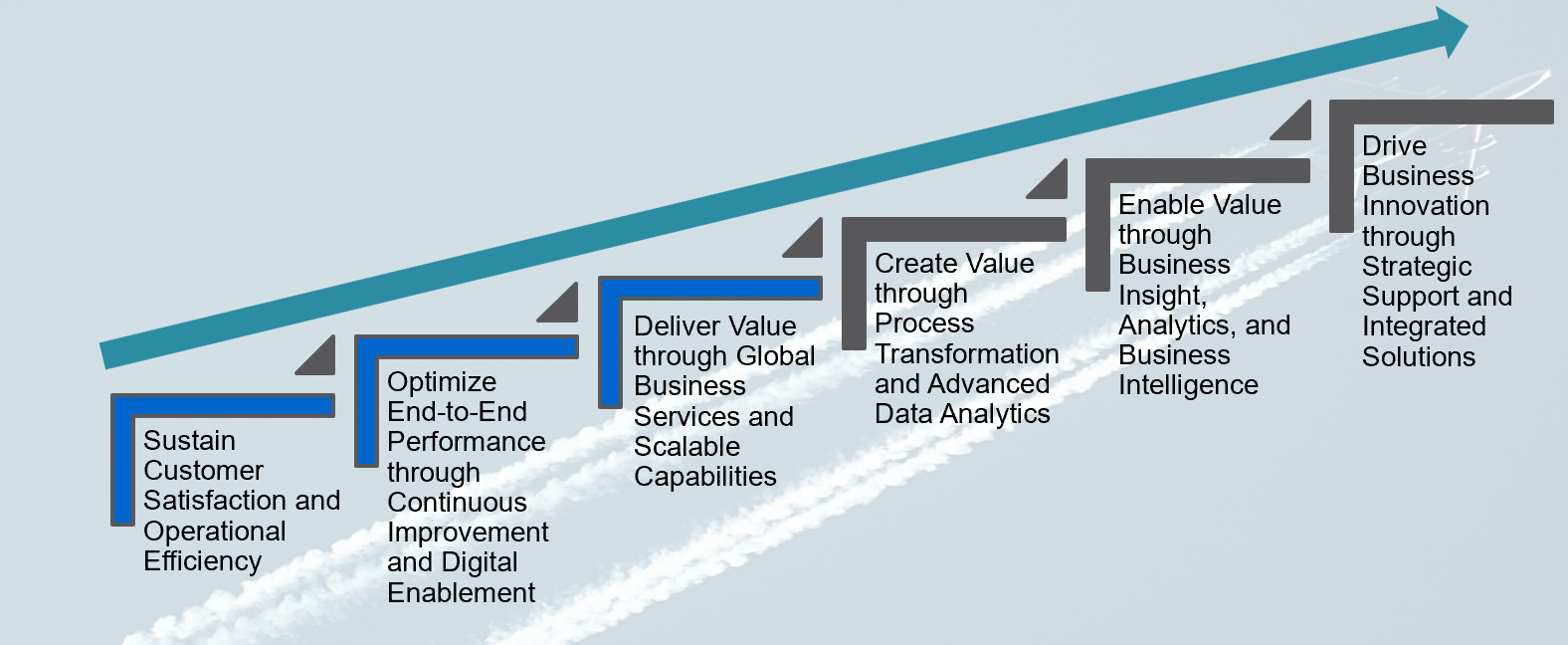
At a certain stage, the role of Global Business Services expands naturally, not because it is formally demanded, but because the business increasingly relies on it. Transactional delivery evolves into end-to-end accountability. Reporting moves beyond consolidation and compliance toward interpretation and insight. Data is no longer produced for its own sake, but analyzed, contextualized, and translated into meaning.
It is at this point that analytics becomes a defining capability. Global Business Services begin to support better managerial judgment by explaining patterns, highlighting risks, and framing trade offs. Their value lies not in the volume of information provided, but in the clarity it brings to decision making across the organization.
What emerges is not a “support function” in the traditional sense, but an internal capability that enables better management decisions. Risk is understood earlier. Trade‑offs become explicit. Leadership attention is freed for matters that truly require it.
At this stage, Global Business Services are no longer discussed merely as an overhead to be managed. They begin to be recognized for the value they actively create for the organization. Their contribution supports better decisions, greater consistency, and stronger outcomes across the business, while their reliability builds confidence and long‑term trust.
Technology plays an important role in enabling this shift, but its effect is often misunderstood. Technology amplifies intent by strengthening existing managerial choices and disciplines. It does not replace them. Where clarity, ownership, and sound judgment are already present, technology reinforces value creation. Where they are absent, it simply makes the gap visible. Artificial intelligence and automation amplify everything that already exists in an organization. They accelerate discipline, but they also expose its absence.
Fragmented processes, unclear ownership, and weak governance do not disappear through technology; they become more visible. Conversely, organizations with strong managerial foundations find that technology extends their reach rather than destabilizing it.
Global Business Services sit at the center of this dynamic. Their view allows technology to be applied with intent, not novelty. Over time, the organization becomes smaller, more skilled, and more influential — less about volume, more about judgment.
Excellence is built, not installed
Excellence is built through consistent practice, not introduced through formal installation. There is no single moment when a GBS organization suddenly becomes excellent. What exists instead is a sequence of deliberate choices, visible results, and steadily growing confidence across the business.
The most successful transformations share a common characteristic. Leadership patience is combined with managerial rigor. Progress is carefully paced, credibility is actively protected, and ambition remains firmly connected to execution.
In an environment where organizations can no longer afford inefficiency and cannot tolerate distraction, Global Business Services have a clear opportunity. They can demonstrate what sound management looks like when applied with consistency and discipline.
Excellence, after all, is not a destination.
It is a way of working.