The Science and Art of Management: What Finance, Tax and GBS Leaders Can Learn from Modern Leadership Theory
Every Finance leader knows the moment
The close calendar is green. The reconciliations are signed off. The dashboard is immaculate. And yet the transformation program is three months behind plan, the shared services centre is quietly losing its best people, and parts of the business still see Finance as the department of “no”. Nothing on the dashboard explains why.
The role of Finance, Tax and Global Business Services (GBS) leaders is being reshaped by automation, analytics, artificial intelligence and rising stakeholder expectations. But beneath the technology agenda sits a question that has not changed at all: what does effective leadership look like in an increasingly complex world?
Why Leadership is still hard, the paradox of plenty
For decades, organizations have invested heavily in systems, processes, controls and governance. They have improved reporting quality, standardized operations and strengthened compliance, and those investments have paid off in transparency, risk management and efficiency.
Yet many leaders still face problems that technical expertise alone cannot solve:
▪ Transformation programs stall despite robust business cases.
▪ Highly optimized processes generate resistance rather than engagement.
▪ Sophisticated data platforms coexist with poor decisions.
▪ Talented teams disengage despite attractive career paths.
If organizations have never had more data, more automation and more sophisticated methodologies, why does leadership remain so difficult? The answer, perhaps, is that management has always been two disciplines at once: a science and an art.
The science: our home ground
The scientific side of management seeks order, structure, predictability and control. It lives in operating models, governance frameworks, KPIs, process maps, financial controls, risk registers and compliance procedures. Its purpose is to reduce uncertainty by generating information, measuring outcomes and supporting rational decisions.
In our functions this tradition is part of daily life. Whether we are closing the books, meeting tax filing obligations, designing a service delivery model or evaluating an investment case, we are trained to value objectivity, consistency and evidence.
That discipline has served organizations exceptionally well; no modern enterprise could function without the rigor and accountability that Finance provides. But the science tells only half the story, because organizations are not mechanical systems. They are social systems.
The art: where outcomes are decided
Every process is performed by people. Every control environment depends on human behavior; a segregation-of-duties matrix is only as strong as the person who decides not to share a password. Every transformation asks individuals to let go of familiar routines and adopt new ways of working. This is where the art of management begins.
Unlike the science, the art rarely offers definitive answers. It calls for interpretation, judgement, empathy and the ability to navigate ambiguity. Its raw materials are culture, trust, communication, influence and meaning.
Reports and dashboards explain what is happening in an organization. They seldom explain why people respond so differently to the same circumstances.
From guardian to partner
Modern leadership theory increasingly recognizes this distinction. Over recent decades, the dominant image of the leader has moved away from command and control toward adaptive, relational and human-centered models. Leaders are seen less as decision-makers at the top of a hierarchy and more as facilitators of learning, creators of meaning and architects of culture.
Ronald Heifetz’s distinction between technical problems and adaptive challenges is particularly useful here. Technical problems have known solutions that experts can implement. Adaptive challenges require people to change their habits, beliefs and ways of working. Many Finance and GBS transformations are adaptive challenges disguised as technical projects, which is why a flawless system go-live can still fail to deliver the business case.
The expectations placed on our functions have shifted accordingly:
▪ Finance is expected to act as a strategic business partner, not only as the keeper of the numbers.
▪ Tax is asked to contribute to value creation, from supply chain and M&A decisions to navigating global minimum tax rules, rather than simply manage risk.
▪ GBS is expected to become an engine of transformation, not a provider of low-cost transactional services.
Historically, these functions derived their legitimacy from technical expertise and functional authority. That expertise remains essential, but on its own it is not enough to mobilize an organization, influence stakeholders or sustain change.
Leading through paradox
The challenge becomes most visible when priorities compete. Organizations want standardization and flexibility, efficiency and innovation, global consistency and local sensitivity, automated decisions and human judgement, all at the same time.
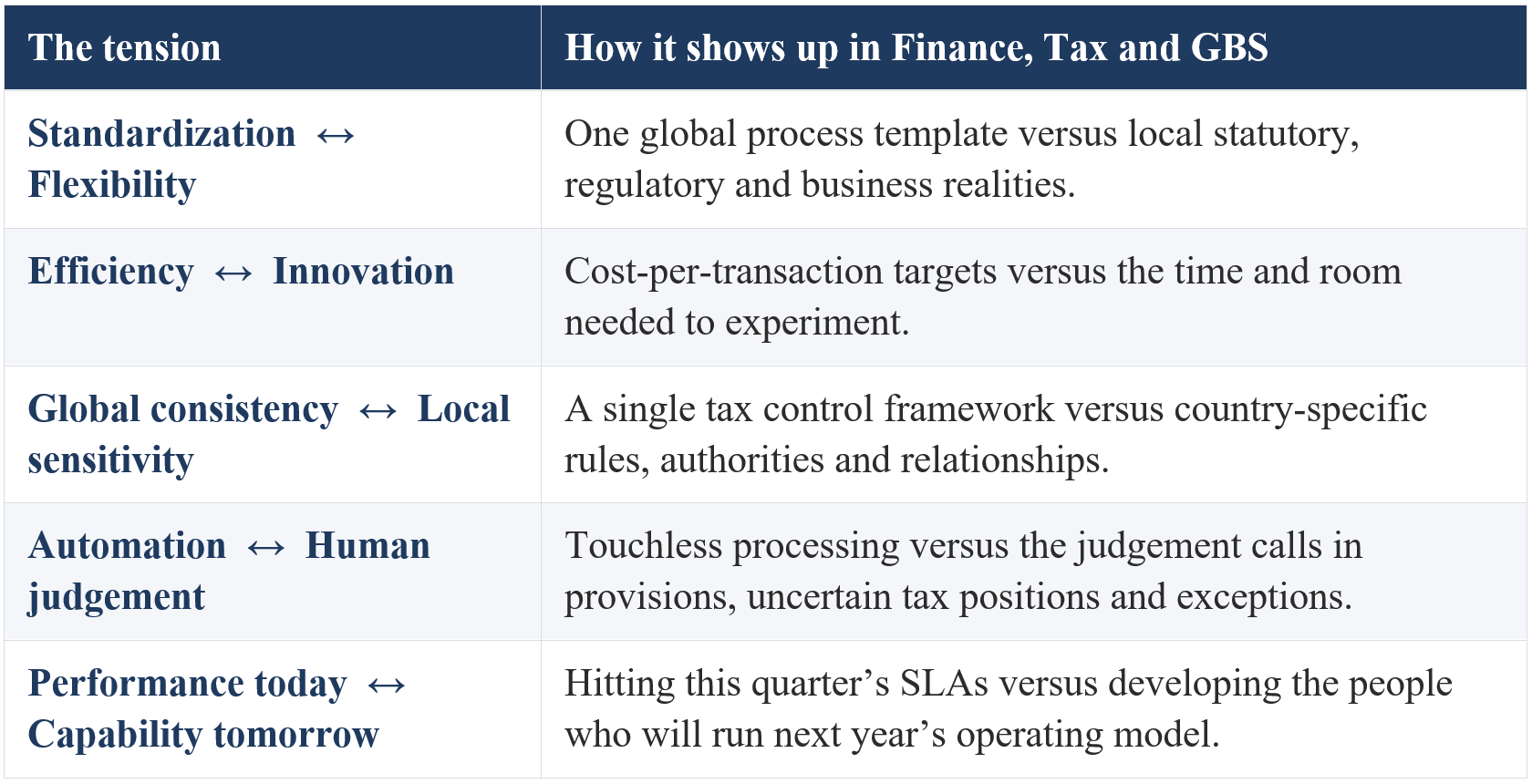
These tensions cannot be eliminated; they can only be managed. Leadership therefore becomes less about solving problems and more about navigating paradoxes, what researchers such as Wendy Smith and Marianne Lewis describe as “both/and” rather than “either/or” thinking.
The most effective leaders hold competing perspectives at once. They value controls and still encourage entrepreneurial thinking. They embrace technology without losing sight of people. They deliver this year’s targets while investing in the capabilities the organization will need in five years.
What AI changes, and what it doesn’t
This balancing act matters even more as artificial intelligence moves into the heart of our functions. Much of the conversation focuses on automation, productivity and efficiency, and those benefits are real. But a deeper question deserves attention: as routine work is automated, what becomes the distinctive contribution of leadership?
The answer may be surprisingly simple. The more successfully we automate technical work, the more valuable distinctly human capabilities become. AI can reconcile accounts in seconds, flag anomalies in the ledger, draft a tax memo and surface patterns no analyst would find. It cannot build trust, inspire confidence, resolve conflict, read the dynamics of a leadership team or create a sense of shared purpose. It cannot stand in front of a team whose roles are changing and make the future feel worth walking toward.
The future belongs neither to technology nor to human intuition alone. It belongs to leaders who can integrate both.
Such leaders understand that data without context can mislead, that strategy without engagement remains an aspiration, and that operational excellence without culture does not last. Above all, they recognize that organizations succeed not because they execute a framework perfectly, but because people choose to commit to a common purpose.
The defining challenge of the decade
Leadership is not simply a technical activity, nor is it a purely interpersonal one. It is the ongoing effort to combine analytical rigor with human understanding, structure with adaptability, and discipline with imagination.
For Finance, Tax and GBS leaders, this may be the defining challenge of the coming decade. Mastery of accounting standards, tax legislation, regulation, operating models and emerging technology will remain the foundation. But success will increasingly depend on something more: the ability to connect the science of management with the art of leading people.
Perhaps the most important lesson from modern leadership theory is therefore not a new framework, methodology or model. It is a reminder that organizations are, in the end, human enterprises. Science helps leaders understand how organizations function. Art helps them understand why people choose to follow. In an era of continuous transformation, uncertainty and technological disruption, that distinction may matter more than ever.
No team reaches the summit because the route map was perfect. It gets there because the people on the rope choose to keep climbing together.