You Can’t Win Every Game
No one expects a championship team to go undefeated. Players have off days, injuries strike, tactics misfire, and sometimes the opponent is simply better. What separates elite teams is not an unbroken winning streak but their ability to respond: to recover physically and mentally, learn from the setback, adjust, and perform again when the next game begins.
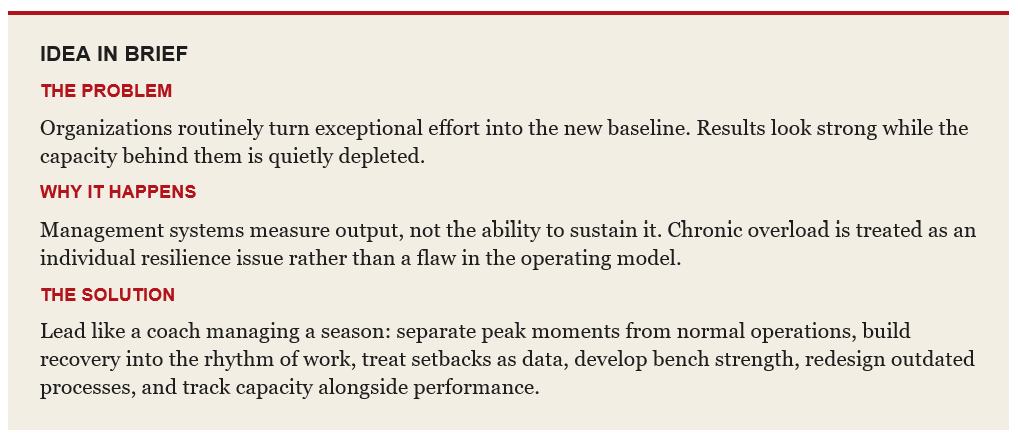
Business tends to follow a different logic. Each quarter brings higher expectations: more projects, more transformation, more efficiency, more responsiveness, more innovation. Last year’s peak becomes this year’s baseline. Exceptional effort quietly hardens into normal capacity, and temporary sprints become permanent ways of working.
For a while, this looks like high performance. But producing results today is not the same as building the capacity to keep producing them. Sustainable performance requires leaders to stop managing as if every quarter were a single decisive game and start managing an entire season. That calls for a different philosophy of performance, built on the disciplines that follow.
Aim for Repeatable Performance, Not Maximum Performance
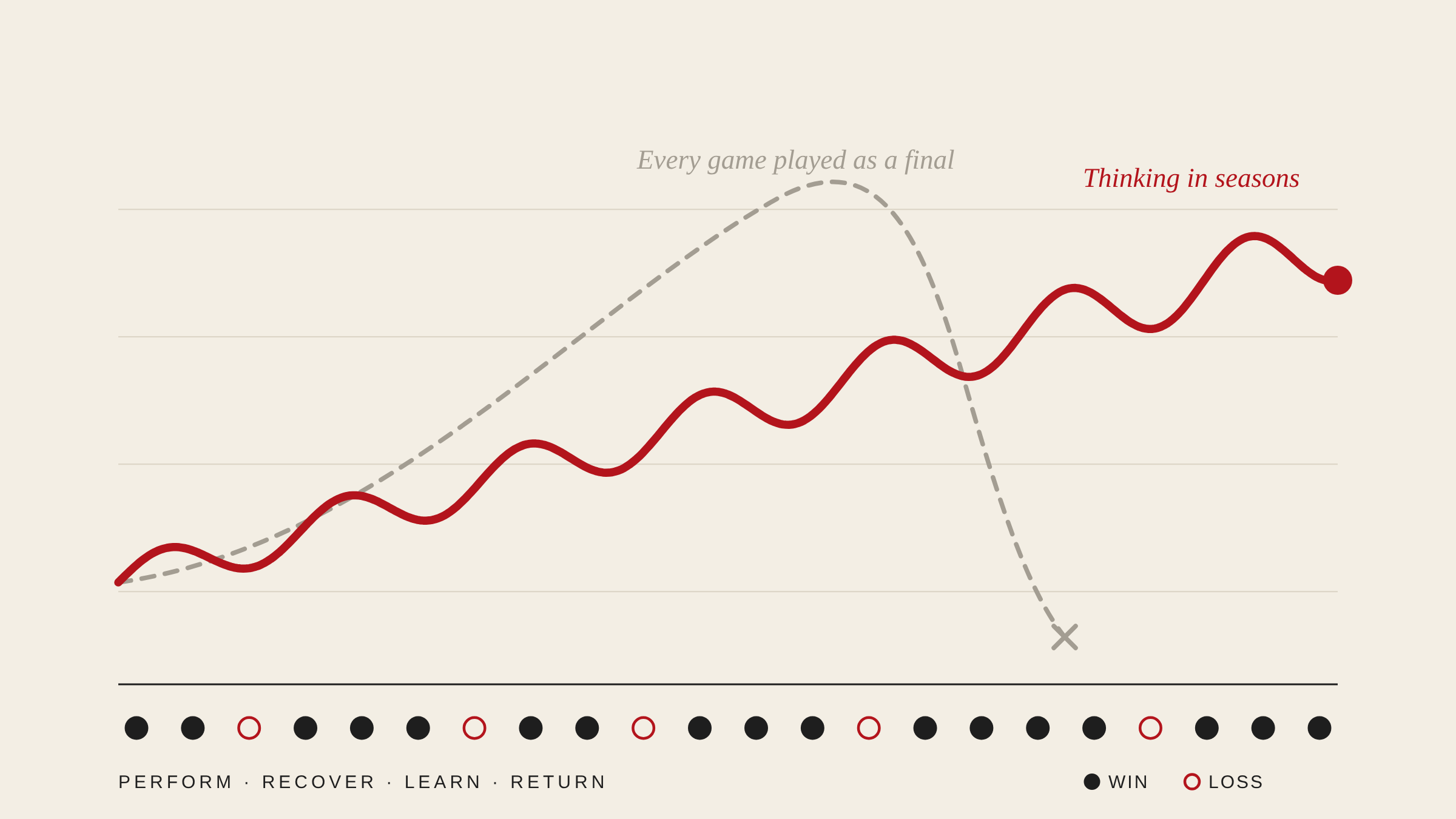
Picture a coach who tells the team, “Play every game as if it were the final.” It sounds inspiring. As a season-long strategy, it is reckless. Athletes cannot sustain peak intensity indefinitely. Training cycles deliberately vary the load, recovery is built into preparation, and coaches rotate players, adjust tactics, protect the injured, and accept short-term trade-offs to stay competitive over the long run.
Few business leaders apply the same discipline. A deadline looms, so the team works late. A transformation demands extra effort. A vacancy opens, and colleagues absorb the work. A crisis requires immediate attention. Each situation is manageable on its own. The trouble starts when exceptional effort stops being exceptional.
Organizations are most exposed after a strong year. If a team delivered 110% last year, leaders may unconsciously treat 110% as this year’s 100%. The extra effort disappears into the baseline, creating a dangerous illusion: the organization appears ever more productive while the capacity sustaining that productivity erodes.
The better question, then, is not How much more can this team deliver? but What level of performance can this team deliver repeatedly without weakening its ability to perform tomorrow? That shift reframes how leaders set targets, allocate resources, and define success itself.
Distinguish the Season From the Game
Every organization faces moments that genuinely demand extraordinary effort: a major transaction, a regulatory deadline, a system implementation, a product launch, a restructuring, a crisis. Sport offers a useful model. Teams prepare differently for decisive matches and raise intensity when the stakes require it, but they never confuse the big game with normal operating conditions.
Leaders should draw the same line. Asking for 120% during a defined peak is entirely reasonable. If 120% is required every month, however, the problem is no longer motivation. It is the operating model.
This is where sustainable performance becomes a leadership responsibility rather than an employee resilience issue. When teams are chronically overloaded, organizations often respond with programs aimed at individuals: stress management, prioritization, time management, reminders to take breaks. These can help, but they cannot offset a system in which demand consistently exceeds capacity.

Leaders must therefore examine not only how people cope with work, but how the work itself is designed.
Make Recovery Part of Performance
This may be the most important lesson business can borrow from sport. In competitive athletics, recovery is not the opposite of training; it is part of training. The same principle should apply to knowledge work.
Yet corporate cultures tend to reward visible activity over recovery. Freed-up calendar time fills instantly with meetings. A completed project simply makes room for the next one. People emerging from an intense stretch move straight to the next priority. There is little institutional recognition that sustained concentration, decision-making, and collaboration also consume capacity.
Effective leaders create rhythm rather than constant intensity. After a demanding period, they resist asking, “What else can we add?” Instead they ask:
■ What should we stop?
■ What did this effort cost the team?
■ Where do we need to restore capacity?
■ What should we learn before we begin again?
Recovery need not mean inactivity. It can mean thinning out meetings, deferring lower-priority initiatives, protecting focus time, rotating responsibilities, or simply resisting the urge to fill every newly available hour. The objective is not comfort. It is readiness.
Treat a Loss as Data, Not a Verdict
Sport also models a healthier relationship with failure. A team can play well and still lose. A star player can make the decisive error. A sound strategy can fail because conditions shifted. Strong teams analyze these moments rather than personalize them: What happened? Which assumptions proved wrong? What must change before the next game?
Organizations often make learning harder because failures quickly become questions of accountability. People learn that bad news must be explained, defended, or softened. The organization then loses twice: once from the original mistake, and again because that mistake yields far less learning than it should.
Leaders can change the dynamic by separating three questions that are too often conflated: What happened? What can we learn? Is there genuinely an accountability issue? Not every disappointing outcome signals poor performance. Sometimes the hypothesis was wrong, conditions changed, or a calculated risk simply didn’t pay off. If leaders want teams to innovate, make decisions, and take intelligent risks, people must know that losing one game does not cost them their place on the team.
Build Bench Strength
Sport offers another lesson that is especially relevant today: a team is stronger than its starting lineup.
Businesses frequently optimize around their top performers. Reliable people receive more responsibility precisely because they are reliable, and the more they deliver, the more the organization depends on them. It feels efficient until it becomes concentration risk. When critical knowledge, relationships, or decisions rest with a handful of individuals, an organization can perform well while growing steadily more fragile.
Great teams build depth. In business, that means developing successors before they are needed, sharing knowledge widely, giving less-experienced employees meaningful responsibility, and resisting the reflex to route every hard problem to the same few people. There is a short-term cost: handing work to someone new may take longer than assigning it to the strongest expert. The alternative, though, is an organization in which today’s efficiency undermines tomorrow’s resilience.

Know When to Change the Game Plan
High-performing teams are also adept at changing tactics. A strategy that worked last season may fail this season: opponents adapt, rosters change, conditions shift.
Organizations, by contrast, grow attached to operating models that once succeeded. The process worked before. The structure delivered results. The reporting is familiar. The meeting exists because it has always existed. Over time, teams spend enormous energy sustaining ways of working that no longer justify the effort.
Sustainable performance therefore depends on more than working harder or recovering better. It requires periodically redesigning the system itself. Leaders should ask:
■ Which activities still create meaningful value?
■ Which processes exist primarily because of history?
■ Where are highly skilled people doing work that could be simplified, automated, or eliminated?
■ Which meetings could become decisions, dashboards, or asynchronous updates?
■ Where have temporary fixes quietly become permanent processes?
The goal is not merely to make people more productive within the current system. Sometimes the system itself must change.
Manage Capacity as Well as Results
Most management systems are built to measure output: revenue, cost, delivery, quality, deadlines, projects completed. These metrics matter, but they describe what the organization has produced, not its ability to keep producing it. A team can hit every target while quietly losing critical knowledge. It can deliver a transformation while exhausting the very people needed to run the transformed business. It can achieve short-term efficiency by concentrating work among a few experts. On a conventional dashboard, everything may still be green.
Leaders focused on sustainable performance track two dimensions at once:
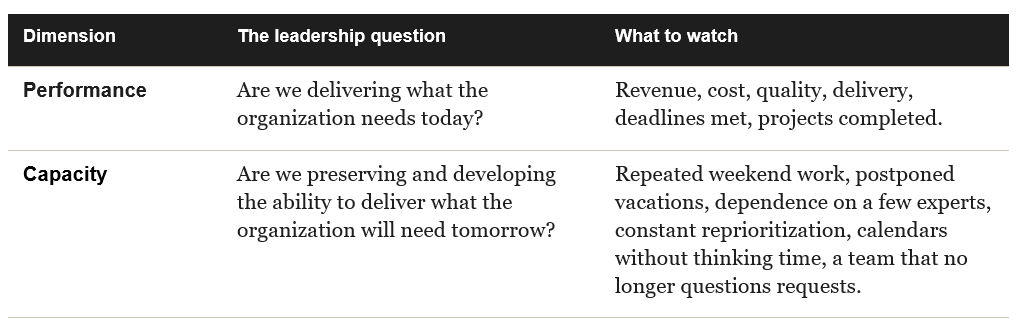
The second dimension deserves far more leadership attention. Its signals rarely fit neatly on a dashboard, but leaders can observe them. They are not merely well-being concerns. They are early indicators of operational fragility.
Lead Like a Coach
Ultimately, the sporting metaphor redefines the leader’s role. A leader is not simply the person demanding a better score. A good coach creates the conditions in which performance becomes possible: selecting the lineup, developing players, adjusting tactics, managing intensity, learning from defeats, and deciding when to push harder and when to recover.
Leadership demands the same judgment. Sometimes the team needs encouragement; sometimes clarity; sometimes protection from competing priorities. Sometimes a leader must ask for extraordinary effort. And sometimes the most important leadership decision is to say: Enough. We are not adding another priority right now. The hard part is knowing which situation you are in.
Think in Seasons
An obsession with continuously maximizing short-term performance can produce the opposite of what leaders intend. A team pushed relentlessly toward peak output may post impressive results for several quarters. But if those results depend on extraordinary effort, a few indispensable individuals, or an ever-expanding workload, the organization has not created high performance. It has borrowed performance from the future.
Sport offers a more realistic ambition. You will not win every game. You will make wrong calls, occasionally miss targets, and face competitors who are sometimes better. Projects will fail, and strong employees will go through difficult periods. The objective is not to build an organization in which none of this happens, but one that responds well when it does: performing when performance matters, recovering when recovery is necessary, learning faster than the competition, building depth, and returning to the next challenge ready to compete.
Sustainable performance is not about winning every game. It is about building a team that can perform, recover, learn, and come back stronger, over an entire season.